Tampa Oak Pest ControlTampa Oak Pest Control

Subterranean Termite Treatment Tampa

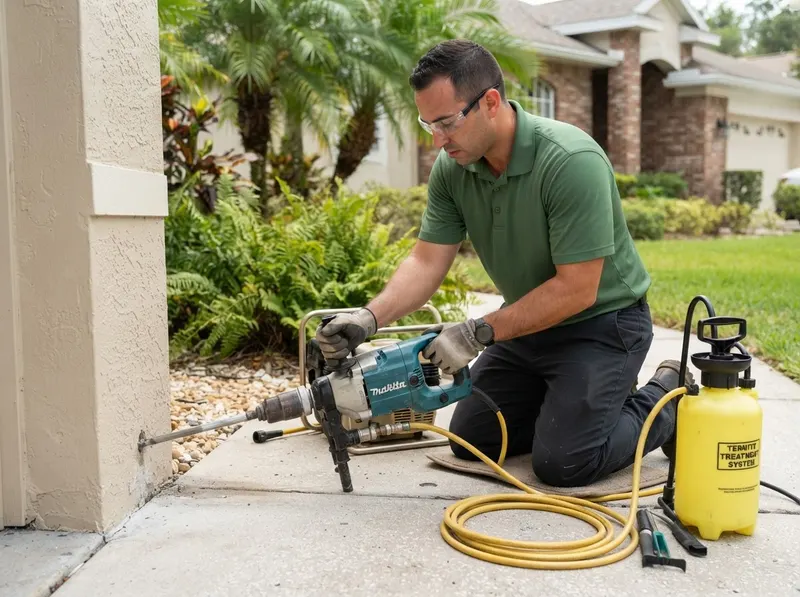
Subterranean termites nest underground in Tampa's high-water-table soil and build vertical mud tubes across masonry footers to access structural framing. Liquid barrier treatments use non-repellent termiticides…
Get My Free Estimate →(239) 688-9770
Subterranean Termite Treatment in Tampa, FL
Quick answer
  • What is included: Exterior perimeter trenching, sub-slab drilling where required, non-repellent liquid termiticide or in-ground monitoring bait stations, and a complete crawlspace or foundation barrier inspection.
  • Turnaround time: On-site evaluations are completed within 24 to 48 hours, with primary perimeter barrier applications taking between 3 to 6 hours depending on structure linear footage.
  • Estimated costs: Treatments carry a base minimum of $250 for localized barrier touch-ups, averaging $800 to $2,500 for full perimeter residential protection based on structural square footage.
  • Targeted organisms: Eastern subterranean termites (Reticulitermes flavipes) and Formosan subterranean termites (Coptotermes formosanus) infesting structural studs, baseboards, and foundation plates.
  • Scheduling process: Contact dispatch directly at (239) 688-9770 to schedule an on-site property inspection with a licensed technician.

Subterranean termites nest underground in Tampa's high-water-table soil and build vertical mud tubes across masonry footers to access structural framing. Liquid barrier treatments use non-repellent termiticides injected into a 6-inch by 6-inch trench alongside the exterior foundation perimeter. Forgetting this continuous perimeter creates gaps; subterranean termites cannot detect the non-repellent compound, pick up the active ingredient on their bodies, and transfer it throughout the underground colony via grooming, resulting in colony elimination over 60 to 90 days.

Properties built on raised foundations in historic neighborhoods like Seminole Heights, Tampa Heights, and Ybor City require crawlspace soil treatments and pier injections, whereas slab-on-grade block homes in New Tampa, Westchase, and Carrollwood rely on continuous exterior perimeter saturation and targeted expansion joint drilling. Near coastal and estuarine zones like Davis Islands, Ballast Point, and along Bayshore Boulevard, shallow water tables often require in-ground bait station installations spaced 10 to 15 feet apart instead of high-volume liquid trenching to prevent run-off into sensitive groundwater.

Direct liquid chemical barriers fit homes with immediate, active structural wood damage requiring rapid termite contact, whereas bait stations fit properties with complex hardscaping or environmental drainage boundaries where soil disruption is prohibited. The trade-off between the two methods involves installation disruption versus eradication speed: liquid soil treatments disturb landscaping borders during trenching but halt colony access immediately, while baiting systems preserve surrounding landscaping but take several months to achieve total colony collapse as workers ingest and share the slow-acting chitin synthesis inhibitors.

Subterranean Termite Treatment cost in Tampa

Localized Spot Treatment & Barrier Re-injection$250 - $450
Standard Monolithic Slab Perimeter Treatment (Up to 1,800 sq ft)$850 - $1,400
Stem Wall or Pier-and-Beam Crawlspace Treatment (Historic Framing)$1,200 - $2,200
Full Exterior In-Ground Bait Station System (Installation + Monitoring)$1,100 - $1,900
High-Pressure Sub-Slab Patio & Garage Drilling Barrier$400 - $800

Every job gets a firm, written price after a free on-site visit.

Common questions

How much does subterranean termite treatment cost in Tampa?
Subterranean termite treatment in Tampa carries a standard base price minimum of $250 for isolated barrier applications, ranging up to $1,800 or more for comprehensive perimeter trenching on single-family homes, with the exact investment confirmed during an on-site inspection based on the home's linear perimeter.
How does Tampa soil moisture affect subterranean termite barrier longevity?
Tampa annual precipitation averages 51 inches, which gradually dilutes outdoor soil treatments over time. A professional subterranean termite barrier applied at label-specified concentrations maintains soil binding efficacy for 5 to 7 years in Hillsborough County sandy soil.
Can subterranean termite treatments harm children or pets in Tampa yards?
Modern non-repellent termiticides bond directly with organic soil particles inside a trench beneath the topsoil layer, meaning the chemical is covered by backfilled dirt and is not accessible to pets or children once the application is finished and the surface soil is replaced.
How are historic Tampa homes with crawlspaces treated differently than slab homes?
Historic wood-frame homes in neighborhoods like Hyde Park and Palma Ceia feature raised pier-and-beam foundations that require crawlspace clearance, interior perimeter trenching, and individual treatment around every support pier, unlike modern slab structures that only require exterior barrier trenching.
What is the difference between subterranean and drywood termite treatments in Tampa?
Subterranean termite treatments address soil-dwelling colonies requiring ground moisture by applying chemical barriers in the earth, whereas drywood termites live entirely within structural lumber above ground and require whole-structure tent fumigation or targeted direct-wood injections.

Get started today

Tell us about your subterranean termite treatment job in Tampa and we'll send a clear, written quote, usually the same day.

Get your free Pest Control Service quote, Tampa

We only use your ZIP to check availability, no spam.