Drywood termite spot treatment addresses localized colonies of Cryptotermes cavifrons and Incisitermes snyderi commonly found in attic rafters, door jambs, and fascia boards across Hillsborough County. In historic…
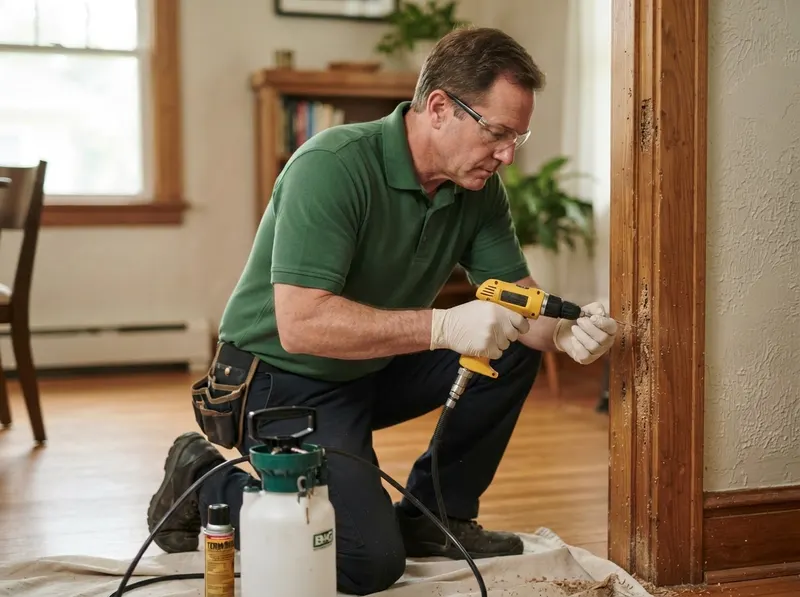
Drywood termite spot treatment addresses localized colonies of Cryptotermes cavifrons and Incisitermes snyderi commonly found in attic rafters, door jambs, and fascia boards across Hillsborough County. In historic bungalow properties in Seminole Heights, Tampa Heights, and Ybor City, heartpine framing and original tongue-and-groove ceilings often support isolated colonies that enter through soffit vents rather than the soil. Spot treatment injects non-repellent transfer agents directly into the kickout-hole galleries where fecal pellets accumulate. This localized approach allows occupants, infants, and domestic pets to remain inside the structure throughout the application, eliminating the hotel stays, food bagging, and roof tile breakage risks associated with sulfuryl fluoride tent fumigation.
Decision guidance depends strictly on colony distribution across the property. When frass deposits are confined to a single window frame in Palma Ceia, an exposed beam in Hyde Park, or a patio overhang in Davis Islands, localized injection provides complete colony eradication through social insect grooming behaviors. However, when exit holes appear across multiple non-contiguous floors or within inaccessible wall voids in large Westchase or New Tampa properties, localized treatment becomes a temporary containment measure rather than a total structural clearance. The practical trade-off centers on cost and convenience versus comprehensive penetration: spot treatment saves thousands of dollars and preserves roof integrity, but it only neutralizes galleries that can be reached and mapped by the technician.
Environmental conditions along coastal zones like Ballast Point and Bayshore Boulevard create distinct moisture dynamics that affect localized chemical persistence. Elevated ambient humidity slows the drying time of surface borates, allowing deeper absorption into untreated dimensional lumber while pests remain active inside dry heartwood. In suburban slab constructions common to Carrollwood, drywood termites often swarm during humid late-spring evenings between April and July, initiating colonies in exterior fascia boards exposed to lawn irrigation spray. Precision treatment isolates these perimeter breaches before alates penetrate internal partition studs, protecting both structural safety and indoor air quality.
Every job gets a firm, written price after a free on-site visit.
Tell us about your drywood termite spot treatment job in Tampa and we'll send a clear, written quote, usually the same day.
 Tampa Oak Pest Control